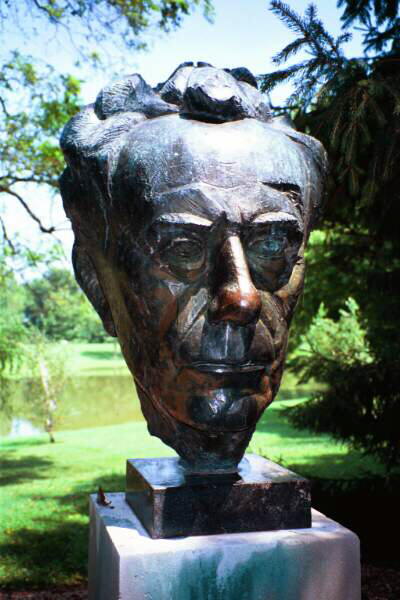
Paul Tillich
German-American theologian and philosopher
Paul Johannes Tillich (20 August 1886 – 22 October 1965) was one of the most influential Protestant theologians and existentialist philosophers of the 20th century, famous for his works The Courage to Be (1952) and Dynamics of Faith (1957). In his major three-volume work Systematic Theology (1951–63), he developed his "method of correlation": an approach of exploring the symbols of Christian revelation as answers to the problems of human existence raised by contemporary existential philosophical analysis.
.JPG)
Quotes edit

- Against Pascal I say: The God of Abraham, Isaac, and Jacob and the God of the philosophers is the same God. He is a person and the negation of himself as a person.
Faith comprises both itself and the doubt of itself. The Christ is Jesus and the negation of Jesus.- Biblical Religion and the Search for Ultimate Reality (1955), p. 80
- It is my conviction that the character of the human condition, like the character of all life, is "ambiguity": the inseparable mixture of good and evil, of true and false, of creative and destructive forces—both individual and social. Sometimes I have the feeling that [irony] shows some awareness of the ambiguity of life—as long as it does not degenerate into mere cynicism. The awareness of the ambiguity of one's own highest achievements (as well as one's own deepest failures) is a definite symptom of maturity.
- “The Ambiguity of Perfection”, Time (May 17, 1963)
The Protestant Era (1948) edit


- Dialectics is the way of seeking for truth by talking with others from different points of view, through "Yes" and "No," until a "Yes" has been reached which is hardened in the fire of many "No's" and which unites the elements of truth promoted in the discussion. It is most unfortunate that in recent years the name "dialectical theology" has been applied to a theology that is strongly opposed to any kind of dialectics and mediation and that constantly repeats the "Yes" to its own and the "No" to any other position. This has made it difficult to use the term "dialectical" to denote theological movements of a really dialectical, that is a mediating, character; and it has resulted in the cheap and clumsy way of dividing all theologians into naturalists and supernaturalists, or into liberals and orthodox. The Protestant Era by Paul Tillich 1948 Introduction
- As Hegel called the place at the end of philosophy the "place of truth," so Marx thought that the proletariat occupies this favored position, and the psychoanalyst attributes it to the completely analyzed personality, and the philosopher of vitalism to the strongest life, to the process of growth, to an élite or a race. There are, according to these ideas, favored moments and positions in history when truth appears and reason is united with the irrational. There are moments, as I myself have emphasized on different occasions, in which "kairos," the right time, is united with "logos," the "eternal truth," and in which the fate of philosophy is decided for a special period.
- "Philosophy and Fate", a translation of his inaugural address as chair of Professor of Philosophy at the University of Frankfort on the Main (June 1929)
- The union of kairos and logos is the philosophical task set for us in philosophy and in all fields that are accessible to the philosophical attitude. The logos is to be taken up into the kairos, universal values into the fullness of time, truth into the fate of existence. The separation of idea and existence has to be brought to an end. It is the very nature of essence to come into existence, to enter into time and fate. This happens to essence not because of something extraneous to it; it is rather the expression of its own intrinsic character, of its freedom. And it is essential to philosophy to stand in existence, to create out of time and fate. It would be wrong if one were to characterize this as a knowledge bound to necessity. Since existence itself stands in fate, it is proper that philosophy should also stand in fate. Existence and knowledge both are subject to fate. The immutable and eternal heaven of truth of which Plato speaks is accessible only to a knowledge that is free from fate—to divine knowledge. The truth that stands in fate is accessible to him who stands within fate, who is himself an element of fate, for thought is a part of existence. And not only is existence fate to thought, but so also is thought fate to existence, just as everything is fate to everything else. Thought is one of the powers of being, it is a power within existence. And it proves its power by being able to spring out of any given existential situation and create something new! It can leap over existence just as existence can leap over it. Because of this characteristic of thought, the view perhaps quite naturally arose that thought may be detached from existence and may therefore liberate man from his hateful bondage to it. But the history of philosophy itself has shown that this opinion is a mistaken one. The leap of thought does not involve a breaking of the ties with existence; even in the act of its greatest freedom, thought remains bound to fate. Thus the history of philosophy shows that all existence stands in fate. Every finite thing possesses a certain power of being of its own and thus possesses a capacity for fate. The greater a finite thing’s autonomous power of being is, the higher is its capacity for fate and the more deeply is the knowledge of it involved in fate. From physics on up to the normative cultural sciences there is a gradation, the logos standing at the one end and the kairos at the other. But there is no point at which either logos or kairos alone is to be found. Hence even our knowledge of the fateful character of philosophy must at the same time stand in logos and in kairos. If it stood only in the kairos, it would be without validity and the assertion would be valid only for the one making it; if it stood only in the logos, it would be without fate and would therefore have no part in existence, for existence is involved in fate.
- "Philosophy and Fate"
- As the Greeks devoted themselves to philosophy, obedient to the logos within the limits of the kairos; as the Middle Ages subordinated the logos to the great kairos upon which their culture was built; as modern philosophy through its kairos adapted itself to the logos of a world-dominating science and technique, so our task is to serve the logos out of the depths of our new kairos, a kairos that is now emerging in the crises and catastrophes of our day. Hence, the more deeply we understand fate — our own personal fate and that of our society — the more our intellectual work will have power and truth.
- "Philosophy and Fate"
The Courage to Be (1952) edit


- At the end of ancient civilization ontic anxiety is predominant, at the end of the Middle Ages moral anxiety, and at the end of the modern period spiritual anxiety.
- p.57
- One of the unfortunate consequences of the intellectualization of man's spiritual life was that the word "spirit" was lost and replaced by mind or intellect, and that the element of vitality which is present in “spirit” was separated and interpreted as an independent biological force. Man was divided into a bloodless intellect and a meaningless vitality. The middle ground between them, the spiritual soul, in which vitality and intentionality are united, was dropped.
- p. 82
- What is the end of all the magnificent means provided by the productive activity of American society? Have not the means swallowed the ends, and does not the unrestricted production of means indicate the absence of ends? Even many born Americans are today inclined to answer the last question affirmatively. But there is more involved in the production of means. It is not the tools and gadgets that are the telos, the inner aim of production; it is the production itself. The means are more than means; they are felt as creations, as symbols of the infinite possibilities implied in man’s productivity. Being-itself is essentially productive.
- pp. 108-109
- The anxiety about death is met in two ways. The reality of death is excluded from daily life to the highest possible degree. The dead are not allowed to show that they are dead; they are transformed into a mask of the living. The other and more important way of dealing with death is the belief in a continuation of life after death, called the immortality of the soul. This is not a Christian and hardly a Platonic doctrine. Christianity speaks of resurrection and eternal life, Platonism of a participation of the soul in the transtemporal sphere of essences. But the modern idea of immortality means a continuous participation in the productive process.
- p. 110
- [American] conformism might approximate collectivism, not so much in economic respects, and not too much in political respects, but very much in the pattern of daily life and thought. Whether this will happen or not, and if it does to what degree, is partly dependent on the power of resistance in those who represent the opposite pole of the courage to be, the courage to be as oneself.
- p. 112
- Individualism is the self-affirmation of the individual self as individual self without regard to its participation in its world. As such it is the opposite of collectivism, the self affirmation of the self as part of a larger whole without regard to its character as an individual self.
- p. 113
- Pietism and methodism reemphasized personal guilt, personal experience, and individual perfection. They were not intended to deviate from ecclesiastical conformity, but unavoidably they did deviate; subjective piety became the bridge of the victorious reappearance of autonomous reason. Pietism was the bridge to Enlightenment. But even Enlightenment did not consider itself individualistic. One believed not in a conformity which is based on biblical revelation but in one which should be based on the power of reason in every individual. The principles of practical and theoretical reason were supposed to be universal among men and able to create, with the help of research and education, a new conformity.
- p. 114
- The courage to be as oneself within the atmosphere of Enlightenment is the courage to affirm oneself as a bridge from a lower to a higher state of rationality. It is obvious that this kind of courage to be must become conformist the moment its revolutionary attack on that which contradicts reason has ceased, namely in the victorious bourgeoisie.
- p. 116
- In a man like Friedrich von Schlegel the courage to be as an individual self produced complete neglect of participation, but it also produced, in reaction to the emptiness of this self-affirmation, the desire to return to a collective. Schlegel, and with him many extreme individualists in the last hundred years, became Roman Catholics. The courage to be as oneself broke down, and one turned to an institutional embodiment of the courage to be as a part.
- p. 117
- The anxiety of fate is conquered by the self-affirmation of the individual as an infinitely significant microcosmic representation of the universe.
- p. 120
- Even loneliness is not absolute loneliness because the contents of the universe are in him.
- p. 121
- Enthusiasm for the universe, in knowing as well as in creating, also answers the question of doubt and meaninglessness. Doubt is the necessary tool of knowledge. And meaninglessness is no threat so long as enthusiasm for the universe and for man as its center is alive.
- p. 121
- The existential attitude is one of involvement in contrast to a merely theoretical or detached attitude. “Existential” in this sense can be defined as participating in a situation, especially a cognitive situation, with the whole of one’s existence.
- pp. 123-124
- There are realms of reality or — more exactly — of abstraction from reality in which the most complete detachment is the adequate cognitive approach. Everything which can be expressed in terms of quantitative measurement has this character. But it is most inadequate to apply the same approach to reality in its infinite concreteness. A self which has become a matter of calculation and management has ceased to be a self. It has become a thing. You must participate in a self in order to know what it is. But by participating you change it. In all existential knowledge both subject and object are transformed by the very act of knowing.
- p. 124
- Knowledge of that which concerns us infinitely is possible only in an attitude of infinite concern.
- p. 125
- Plato … teaches the separation of the human soul from its “home” in the realm of pure essences. Man is estranged from what he essentially is. His existence in a transitory world contradicts his essential participation in the eternal world of ideas.
- p. 127
- In Calvinism and sectarianism man became more and more transformed into an abstract moral subject, as in Descartes he was considered an epistemological subject.
- p. 133
- The first element is the experience of the power of being which is present even in the face of the most radical manifestation of non being. If one says that in this experience vitality resists despair, one must add that vitality in man is proportional to intentionality.
The vitality that can stand the abyss of meaninglessness is aware of a hidden meaning within the destruction of meaning.- p. 177
- The second element in absolute faith is the dependence of the experience of nonbeing on the experience on being and the dependence of the experience of meaninglessness on the experience of meaning. even in the state of despair one has enough being to make despair possible.
- p. 177
- There is a third element in absolute faith, the acceptance of being accepted. Of course, in the state of despair there is nobody and nothing that accepts. But there is the power of acceptance itself which is experienced. Meaninglessness, as long as it is experienced, includes an experience of the "power of acceptance". To accept this power of acceptance consciously is the religious answer of absolute faith, of a faith which has been deprived by doubt of any concrete content, which nevertheless is faith and the source of the most paradoxical manifestation of the courage to be.
- p. 177
- One can become aware of it in the anxiety of fate and death when the traditional symbols, which enable men to stand the vicissitudes of fate and the horror of death have lost their power. When "providence" has become a superstition and "immortality" something imaginary that which once was the power in these symbols can still be present and create the courage to be in spite of the experience of a chaotic world and a finite existence. The Stoic courage returns but not as the faith in universal reason. It returns as the absolute faith which says Yes to being without seeing anything concrete which could conquer the nonbeing in fate and death.
And one can become aware of the God above the God of theism in the anxiety of guilt and condemnation when the traditional symbols that enable men to withstand the anxiety of guilt and condemnation have lost their power. When "divine judgment" is interpreted as a psycholog- ical complex and forgiveness as a remnant of the "father-image," what once was the power in those symbols can still be present and create the courage to be in spite of the experience of an infinite gap between what we are and what we ought to be. The Lutheran courage returns but not supported by the faith in a judging and forgiving God. It returns in terms of the absolute faith which says Yes although there is no special power that conquers guilt. The courage to take the anxiety of meaninglessness upon oneself is the boundary line up to which the courage to be can go. Beyond it is mere nonbeing. Within it all forms of courage are re-established in the power of the God above the God of theism. The courage to be is rooted in the God who appears when God has disappeared in the anxiety of doubt.- Closing statement, p. 190
Systematic Theology (1951–63) edit

- A theological system is supposed to satisfy two basic needs: the statement of the truth of the Christian message and the interpretation of this truth for every new generation. Theology moves back and forth between two poles, the eternal truth of its foundation and the temporal situation in which the eternal truth must be received. Not many theological systems have been able to balance these two demands perfectly.
- The object of theology is what concerns us ultimately. Only those propositions are theological which deal with their object in so far as it can become a matter of ultimate concern for us.
- The question now arises: What is the content of our ultimate concern? What does concern us unconditionally? The answer, obviously, cannot be a special object, not even God, for the first criterion of theology must remain formal and general. If more is to be said about the nature of our ultimate concern, it must be derived from an analysis of the concept “ultimate concern.” Our ultimate concern is that which determines our being or not-being. Only those statements are theological which deal with their object in so far as it can become a matter of being or not-being for us.
- Man is infinitely concerned about the infinity to which he belongs, from which he is separated, and for which he is longing. Man is totally concerned about the totality which is his true being and which is disrupted in time and space. Man is unconditionally concerned about that which conditions his being beyond all the conditions in him and around him. Man is ultimately concerned about that which determines his ultimate destiny beyond all preliminary necessities and accidents.
- Philosophy asks the question of reality as a whole; it asks the question of the structure of being. And it answers in terms of categories, structural laws, and universal concepts.
- Philosophy and theology ask the question of being. But they ask it from different perspectives. Philosophy deals with the structure of being in itself; theology deals with the meaning of being for us. From this difference convergent and divergent trends emerge in the relation of theology and philosophy.
- Life remains ambiguous as long as there is life. The question implied in the ambiguities of life derives to a new question, namely, that of the direction in which life moves. This is the question of history. Systematically speaking, history, characterized as it as by its direction
- Vol.2, p. 4
Love, Power and Justice (1954) edit
- The Great Commandment demands of everyone the total love of God and the love one's neighbour according to the measure of man's natural self-affirmation. If love is emotion, how can it be demanded? Emotions cannot be demanded. We cannot demand them of ourselves. If we try, something artificial is produced which shows the traits of what had to be suppressed in its production. Repentance, intentionally produced, hides self-complacency in perversion. Love, intentionally produced, shows indifference or hostility in perversion. The means: love as an emotion cannot be commanded. Either love is something other than emotion or the Great Commandment is meaningless.
- p. 4
- There is no truth without the form of truth, namely justice.
- p. 21
- Without the eros toward truth, theology would not exist.
- p. 31
The New Being (1955) edit


_reaching_towards_the_Sun_(7571264792).jpg)
- God's forgiveness is unconditional. There is no condition whatsoever in man which would make him worthy of forgiveness. If forgiveness were conditional, conditioned by man, no one could be accepted and no one could accept himself. We know that this is our situation, but we loathe to face it.
- Chap. 1: "To Whom Much is Forgiven..."
- We cannot love unless we have accepted forgiveness, and the deeper our experience of forgiveness is, the greater is our love.
- Chap. 1: "To Whom Much is Forgiven..."
- He who loves God is also able to accept life and to love it. This is not the same as to love God. For many pious people in all generations the love of God is the other side of the hatred for life. And there is much hostility towards life in all of us, even in those who have completely surrendered to life. Our hostility towards life is manifested in cynicism and disgust, in bitterness and continuous accusations against life. We feel rejected by life, not so much because of its objective darkness and threats and horrors, but because of our estrangement from its power and meaning. He who is reunited with God, the creative Ground of life, the power of life in everything that lives, is reunited with life. He feels accepted by it and he can love it. He understands that the greater love is, the greater the estrangement which is conquered by it. In metaphorical language I should like to say to those who feel deeply their hostility towards life: Life accepts you; life loves you as a separated part of itself; life wants to reunite you with itself, even when it seems to destroy you.
- Chap. 1: "To Whom Much is Forgiven..."
- If I were asked to sum up the Christian message for our time in two words, I would say with Paul: It is the message of a "New Creation." We have read something of the New Creation in Paul’s second letter to the Corinthians. Let me repeat one of his sentences in the words of an exact translation: "If anyone is in union with Christ he is a new being; the old state of things has passed away; there is a new state of things." Christianity is the message of the New Creation, the New Being, the New Reality which has appeared with the appearance of Jesus who for this reason, and just for this reason, is called the Christ. For the Christ, the Messiah, the selected and anointed one is He who brings the new state of things.
- Chap. 2: The New Being
- No religion as such produces the New Being. Circumcision is a religious rite, observed by the Jews; sacrifices are religious rites, observed by the pagans; baptism is a religious rite, observed by the Christians.
All these rites do not matter — only a New Creation. And since these rites stand, in the words of Paul, for the whole religion to which they belong, we can say: No religion matters — only a new state of things. Let us think about this striking assertion of Paul. What it says first is that Christianity is more than a religion; it is the message of a New Creation.- Chap. 2: The New Being
- There are the great religions beside Christianity, Hinduism, Buddhism, Islam and the remnants of classical Judaism; they have their myths and their rites — so to speak their "circumcision" — which gives each of them their distinction. There are the secular movements: Fascism and Communism, Secular Humanism, and Ethical Idealism. They try to avoid myths and rites; they represent, so to speak, uncircumcision. Nevertheless, they also claim ultimate truth and demand complete devotion. How shall Christianity face them? Shall Christianity tell them: Come to us, we are a better religion, our kind of circumcision or uncircumcision is higher than yours? Shall we praise Christianity, our way of life, the religious as well as the secular? Shall we make of the Christian message a success story, and tell them, like advertisers: try it with us, and you will see how important Christianity is for everybody? Some missionaries and some ministers and some Christian laymen use these methods. They show a total misunderstanding of Christianity. The apostle who was a missionary and a minister and a layman all at once says something different. He says: No particular religion matters, neither ours nor yours. But I want to tell you that something has happened that matters, something that judges you and me, your religion and my religion. A New Creation has occurred, a New Being has appeared; and we are all asked to participate in it. And so we should say to the pagans and Jews wherever we meet them: Don’t compare your religion and our religion, your rites and our rites, your prophets and our prophets, your priests and our priests, the pious amongst you, and the pious amongst us. All this is of no avail! And above all don’t think that we want to convert you to English or American Christianity, to the religion of the Western World. We do not want to convert you to us, not even to the best of us. This would be of no avail. We want only to show you something we have seen and to tell you something we have heard: That in the midst of the old creation there is a New Creation, and that this New Creation is manifest in Jesus who is called the Christ.
- Chap. 2: The New Being
- The New Being is not something that simply takes the place of the Old Being. But it is a renewal of the Old which has been corrupted, distorted, split and almost destroyed. But not wholly destroyed. Salvation does not destroy creation; but it transforms the Old Creation into a New one. Therefore we can speak of the New in terms of a re-newal: The threefold "re," namely, re-conciliation, re-union, resurrection.
- Chap. 2: The New Being
- A new reality has appeared in which you are reconciled. To enter the New Being we do not need to show anything. We must only be open to be grasped by it, although we have nothing to show.
Being reconciled — that is the first mark of the New Reality. And being reunited is its second mark. Reconciliation makes reunion possible. The New Creation is the reality in which the separated is reunited. The New Being is manifest in the Christ because in Him the separation never overcame the unity between Him and God, between Him and mankind, between Him and Himself. This gives His picture in the Gospels its overwhelming and inexhaustible power.
In Him we look at a human life that maintained the union in spite of everything that drove Him into separation. He represents and mediates the power of the New Being because He represents and mediates the power of an undisrupted union.- Chap. 2: The New Being
- Where the New Reality appears, one feels united with God, the ground and meaning of one’s existence. One has what has been called the love of one’s destiny, and what, today, we might call the courage to take upon ourselves our own anxiety. Then one has the astonishing experience of feeling reunited with one’s self, not in pride and false self-satisfaction, but in a deep self-acceptance. One accepts one’s self as something which is eternally important, eternally loved, eternally accepted. The disgust at one’s self, the hatred of one’s self has disappeared. There is a center, a direction, a meaning for life. All healing — bodily and mental — creates this reunion of one’s self with one’s self. Where there is real healing, there is the New Being, the New Creation.
But real healing is not where only a part of body or mind is reunited with the whole, but where the whole itself, our whole being, our whole personality is united with itself. The New Creation is healing creation because it creates reunion with oneself. And it creates reunion with the others. Nothing is more distinctive of the Old Being than the separation of man from man. Nothing is more passionately demanded than social healing, than the New Being within history and human relationships. Religion and Christianity are under strong accusation that they have not brought reunion into human history. Who could deny the truth of this challenge.
Nevertheless, mankind still lives; and it could not live any more if the power of separation had not been permanently conquered by the power of reunion, of healing, of the New Creation.- Chap. 2: The New Being
- The word "resurrection" has for many people the connotation of dead bodies leaving their graves or other fanciful images. But resurrection means the victory of the New state of things, the New Being born out of the death of the Old.
Resurrection is not an event that might happen in some remote future, but it is the power of the New Being to create life out of death, here and now, today and tomorrow. Where there is a New Being, there is resurrection, namely, the creation into eternity out of every moment of time. The Old Being has the mark of disintegration and death. The New Being puts a new mark over the old one. Out of disintegration and death something is born of eternal significance. That which is immersed in dissolution emerges in a New Creation. Resurrection happens now, or it does not happen at all. It happens in us and around us, in soul and history, in nature and universe.
Reconciliation, reunion, resurrection — this is the New Creation, the New Being, the New state of things.- Chap. 2: The New Being
- Where else, besides in scholarly work, should we look for truth? There are many in our period, young and old, primitive and sophisticated, practical and scientific, who accept this answer without hesitation. For them scholarly truth is truth altogether. Poetry may give beauty, but it certainly does not give truth. Ethics may help us to a good life, but it cannot help us to truth. Religion may produce deep emotions, but it should not claim to have truth. Only science gives us truth. It gives us new insights into the way nature works, into the texture of human history, into the hidden things of the human mind. It gives a feeling of joy, inferior to no other joy. He who has experienced this transition from darkness, or dimness, to the sharp light of knowledge will always praise scientific truth and understanding and say with some great medieval theologians, that the principles through which we know our world are the eternal divine light in our souls. And yet, when we ask those who have finished their studies in our colleges and universities whether they have found there a truth which is relevant to their lives they will answer with hesitation. Some will say that they have lost what they had of relevant truth; others will say that they don’t care for such a truth because life goes on from day to day without it. Others will tell you of a person, a book, an event outside their studies which gave them the feeling of a truth that matters. But they all will agree that it is not the scholarly work which can give truth relevant for our life.
Where else, then, can we get it? "Nowhere," Pilate answers in his talk with Jesus. "What is truth?" he asks, expressing in these three words his own and his contemporaries’ despair of truth, expressing also the despair of truth in millions of our contemporaries, in schools and studios, in business and professions. In all of us, open or hidden, admitted or repressed, the despair of truth is a permanent threat. We are children of our period as Pilate was. Both are periods of disintegration, of a world-wide loss of values and meanings. Nobody can separate himself completely from this reality, and nobody should even try. Let me do something unusual from a Christian standpoint, namely, to express praise of Pilate—not the unjust judge, but the cynic and sceptic; and of all those amongst us in whom Pilate’s question is alive. For in the depth of every serious doubt and every despair of truth, the passion for truth is still at work. Don’t give in too quickly to those who want to alleviate your anxiety about truth. Don’t be seduced into a truth which is not really your truth, even if the seducer is your church, or your party, or your parental tradition. Go with Pilate, if you cannot go with Jesus; but go in seriousness with him!- Chap. 8: "What Is Truth?"
Dynamics of Faith (1957) edit
.jpg)
- Faith is the state of being ultimately concerned. The content matters infinitely for the life of the believer, but it does not matter for the formal definition of faith. And this is the first step we have to make in order to understand the dynamics of faith.
- Faith as ultimate concern is an act of the total personality. It happens in the center of the personal life and includes all its elements. Faith is the most centered act of the human mind. It is not a movement of a special section or a special function of man's total being. They all are united in the act of faith. But faith is not the sum total of their impacts. It transcends every special impact as well as the totality of them and it has itself a decisive impact on each of them.
Quotes about Tillich edit

- Buber and Tillich each took similar paths toward their common destination of religious socialism. Both had been influenced early in their careers by the 19th century German philosopher Nietzsche's rejection of bourgeois culture in his classic book, Thus Spoke Zarathustra, and were further influenced by Karl Marx's doctrine of human self-estrangement and objectification in capitalist society while rejecting his anti-religious bias. Moreover, Buber and Tillich, along with all religious socialists, rejected the Marxist “revolutionary dictatorship” of the proletariat. This would represent the extreme of heteronomy for Tillich and the political manifestation of the I-it relationship expressed by Buber that is based on human instrumentalism. … Tillich initially promoted an "idealistic anarchism" in the sense that he envisioned a theonomous culture arising from "communities themselves and their spiritual substance" instead of being promoted by the state. They would eventually part ways to some extent, with Buber continuing to promote a "federalistic communal socialism" yet not rejecting the political component of social life, while Tillich promoted the possibility of a central government that is not absolute in a theonomous society.
- Marc A. Krell, in Modern Judaism and Historical Consciousness : Identities, Encounters. Perspectives (2007), edited by Andreas Gotzmann and Christian Wiese; Ch. 8 : Fashioning a Neutral Zone: Jewish and Protestant Socialists challenge Religionswissenschaft in Weimar Germany, § 3 : Fashioning a Neutral Zone of Religious Socialism, p. 218
External links edit


- Tillich profile, and synopsis of Gifford Lectures
- North American Paul Tillich Society
- James Rosati's sculpture of Tillich's head in the Paul Tillich Park in New Harmony, Indiana
- Tillich Park Finger Labyrinth. Walk Tillich Park while discerning Tillich's theology. Created by Rev. Bill Ressl after an inspirational walk in Tillich Park in New Harmony, Indiana.
- Sermons and lectures – audio recordings on
- Paul Tillich television interview Paul Tillich in four separate interviews entitled (1) philosophy and religion, (2) religion in the philosophy of life, (3) religion and psychotherapy, and (4) philosophy and art. It is conducted by members of the faculty of Pittsburgh Theological Seminary and produced as part of the WQED of Pittsburgh “Heritage” series on NET. The date is unclear. 1st of 12 YouTube segments.
- The Courage to Be in the Internet Archive